Multi-Objective Microgrid Design Optimization
This case study shows how multi-objective search can reveal resilient, lower-emission system designs with transparent cost tradeoffs.
The Problem
Microgrid design decisions must balance competing goals, including cost, reliability, and emissions, under uncertain demand and resource availability.
System Model and Constraints
The model evaluates generation and storage sizing with operational constraints such as load balance, capacity limits, and reserve coverage over representative time periods.
Tradeoff and Pareto Frontier
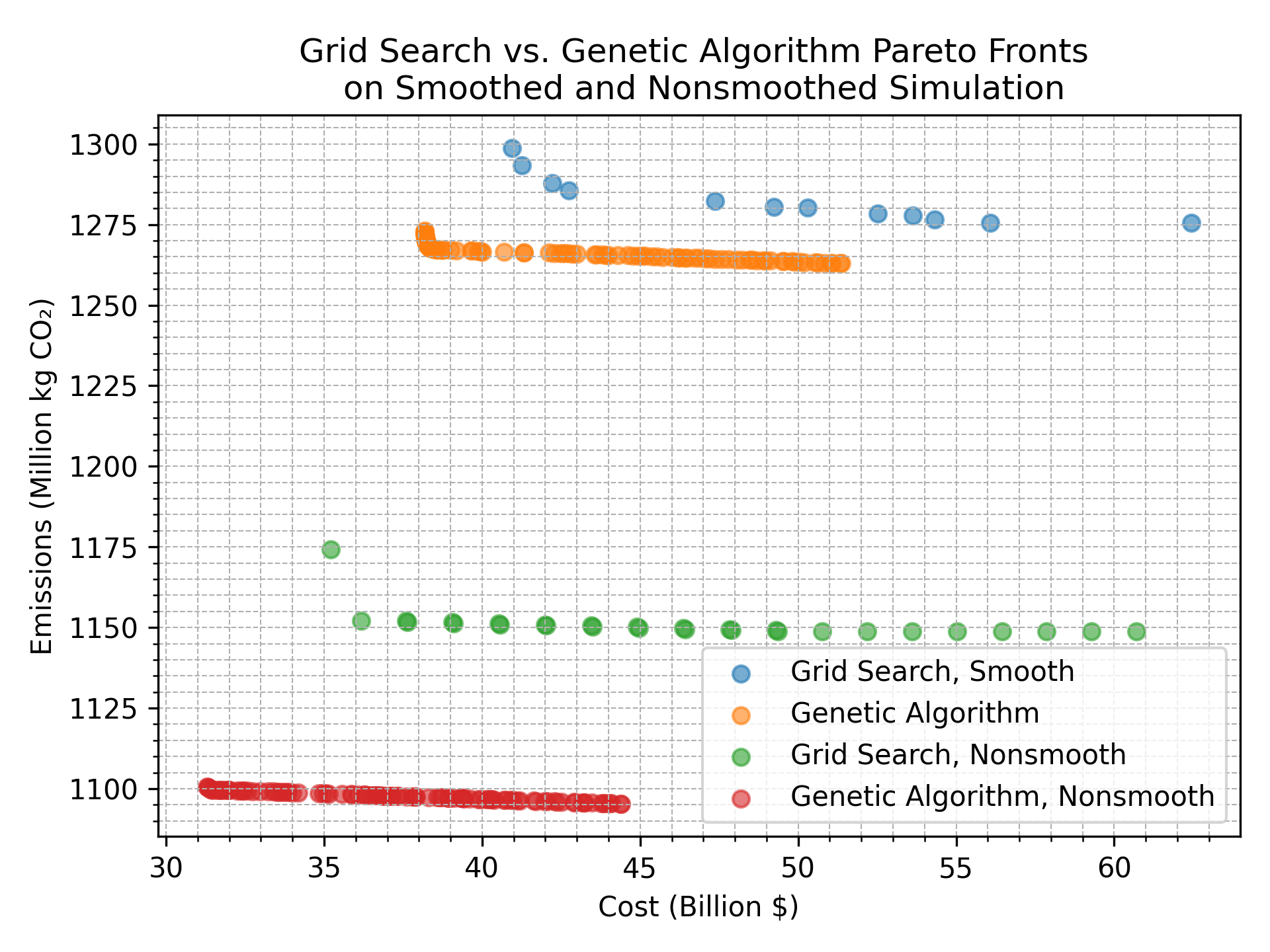
The genetic algorithm achieves lower-emission solutions at comparable cost and is more robust in the non-smooth case where gradient-based methods struggle.
Methods Compared
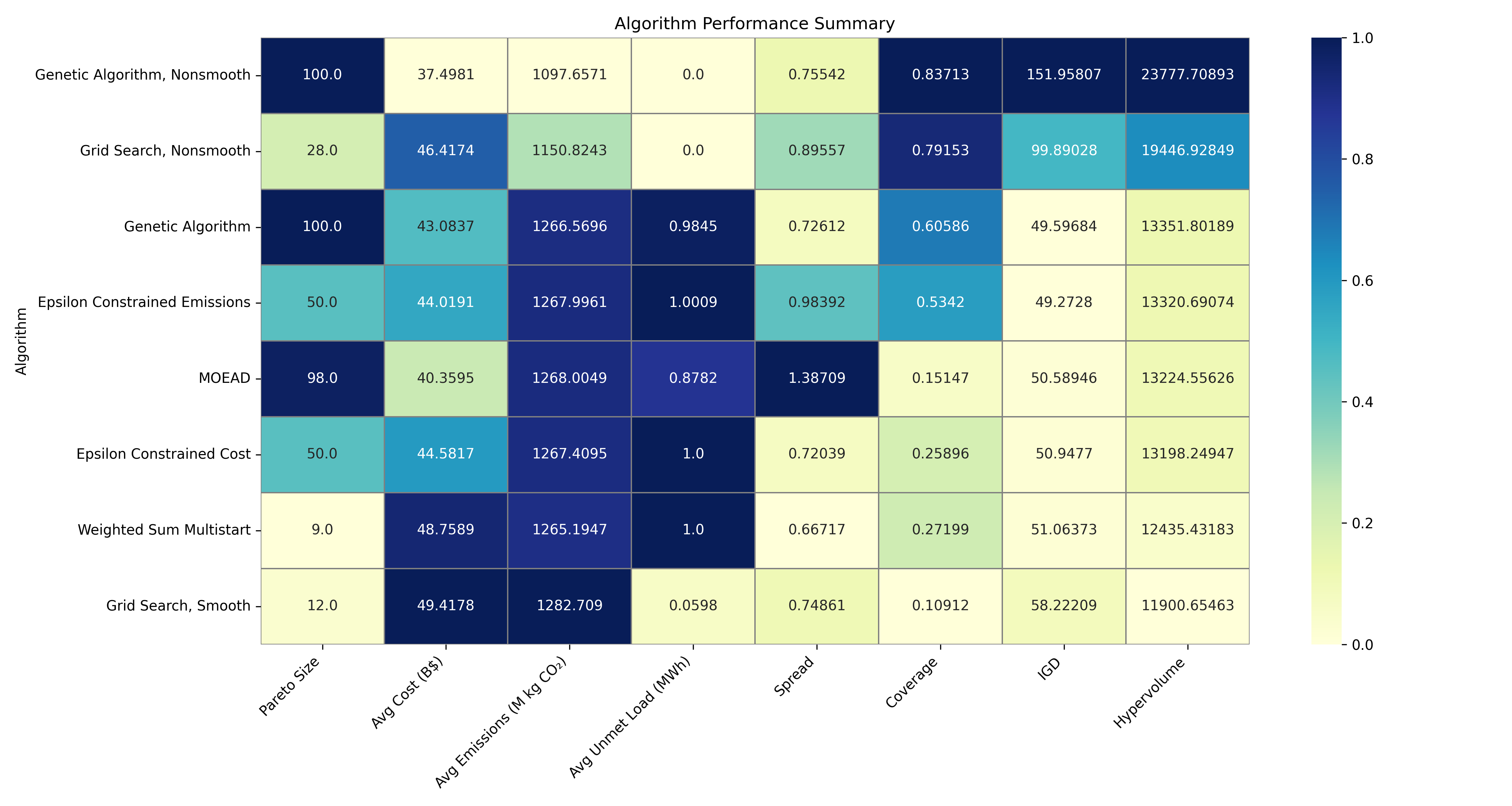
Weighted Sum, Epsilon Constraint, NSGA-II, MOEA/D, and Grid Search were compared using Pareto set size, average cost, average emissions, average unmet load, spread, coverage, IGD, and hypervolume. Across these convergence, diversity, and reliability metrics, the genetic algorithm performed best overall.
Runtime Comparison
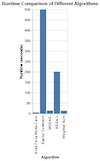
The runtime chart shows that GA and MOEA/D deliver competitive compute performance while maintaining strong solution quality. Both methods are substantially more efficient than exhaustive or grid-based search when exploring larger design spaces. This makes them practical for repeated scenario studies and sensitivity runs.
Key Findings
- Algorithm selection materially impacts solution quality in non-smooth systems.
- Smoothing changes the feasible region and can distort tradeoffs.
- The genetic algorithm provides strong Pareto coverage with low runtime and robust convergence.
Tools and Stack
Python optimization workflows, scenario simulation scripts, and lightweight plotting were used to run experiments and summarize decision-ready results.
Next Improvements
Future work includes uncertainty-aware planning, richer battery degradation modeling, and automated sensitivity dashboards for stakeholder review.
Technical Appendix
Full academic report with detailed optimization formulation, derivations, and references.
View Full Report (PDF)